How to Become a Copywriter

People often ask me how I became a copywriter in the first place. I half-jokingly say that I “printed up a bunch of business cards, put my name on them, then added ‘copywriter’ underneath.”

It’s a bit of an oversimplification, but that’s essentially how I began my business as a freelance copywriter.

There is no standard definition of “copywriter.” A technical copywriter may focus on documentation and processes, while a creative copywriter writes for marketing and advertising purposes. More on that in my blog about technical vs. creative copywriting here.

There exists copywriters who write exclusively for advertising; others that write direct response or sales letters; some are website copywriters, who may also be called “content writers” interchangeably.

If you are thinking about becoming a copywriter as a career, here are some things to consider.

How Do I Become A Copywriter With No Experience?

Unlike other jobs, copywriting is a profession with a low barrier of entry – copywriting is not regulated, nor is it self-regulated or gate-kept by a guild or union. Anyone with an internet connection and a laptop can set up a website or register for a job board such as Upwork or Fiverr and ply their trade.

Training as a copywriter isn’t standardised, nor is it essential. You can read books about copywriting and attempt to emulate the greats such as David Ogilvy or Dan Kennedy. If you have a good – and I mean being in the top ten to five percent of the population - command of English (or your home language) you can “make it” as a copywriter.

Basic Copywriting Skills

The main suite of skills you’ll need to be a copywriter are:

  • Written communication

  • Creativity or lateral thinking

  • Problem solving

  • Oral communication

  • Time management

  • Editing

  • Business management - if you are going freelance

Studying some type of business finance or management is essential. I recommend the Finance Academy course Managing Business Finance by Chinmay Ananda to get you up to speed.

The Academic Route

In Australia, if you absolutely love learning in an academic setting (and I did), you could study a Bachelor of Arts concentrating in English or Media and Communication. A Bachelor of Business or a Bachelor of Commerce in Marketing may also include units on copywriting.

However, if you find you need to hone your skills without spending thousands of dollars (and hours) at university, I personally recommend you study a Certificate IV in Professional Writing and Editing. This teaches you the fundamentals of written English communication in a work context.

How Do I Start Out As A Copywriter?

If you have your heart set on copywriting as a career, try to apply for as much work experience as you can at your high school or TAFE. Try to get work experience at as many types of agencies or houses as possible – advertising agencies, marketing firms, content writing houses, communications, or PR agencies – so you get a feel for what type of copywriting and editing you are strong at; and what needs work.

In this work context, you should also be able to work to tight deadlines and confusing, sometimes contradictory briefs. You’ll also learn not to take criticism personally and learn from your mistakes. Letting go of attachment to your work is also a must; in the content writing world especially, you are giving voice to someone else!

While talent and experience are essential, or even just the willingness to learn, having the right tools can make your journey much smoother. You do not need an elaborate setup to get started; a reliable laptop, a comfortable home office space, and a stable internet connection will often cover the basics. As your career grows, you can invest in software for project management, grammar checking, and collaboration, but in the beginning, a simple, organised workspace is often all you need to start producing great work.

The Advertising Advertising Paradox

As mentioned before, the barrier to entry for a copywriter is low. You ideally need a website to show off your portfolio and act as a lead magnet. If you don’t have a portfolio, approach friends and family and offer to refresh their resumes or websites for them.

However, you need to write ads that not only advertise your proficiency as a copywriter, but act as a “free sample” of your work for other businesses. If it can convince them, chances are you can convince their audience their product or service is worth buying too.

DO. NOT. WORK. FOR. FREE.

Because you are just starting out, you will be tempted by offers from start-ups or ne’er-do-wells asking you to work for “exposure.”

Ignore these people. They are choosing beggars at the very least.

Working for free is not only illegal in Australia, but it also makes it worse for everyone else in the industry.

The number of emails I get saying “I’ll get my cousin/friend/best mate’s brother’s wife to do it for free” would make the average person blush. I simply tell them – if they’re so good, why are you bothering me?

A 400-word blog post may take me 20 minutes to write. However, just like the mechanic who knows exactly where to strike his tiny hammer to fix a car in five seconds – you’re not paying for my time, you’re paying for my expertise.

Even if you hit up family and friends for work, set a price. A junior, fresh out of uni/TAFE/beginner should be able to earn $25-30/hr if they can demonstrate a good level of professionalism and proficiency.

As I always say, be “uneditable” - the less work you make for editors, the more you jobs you’re picked for.

With all that in mind, will you make copywriting your career?


Want to know more? Want a professional to write your copy and content? Get award-winning copywriting from I Sell Words.


If You Want To Be Heard, Start Listening

Kids of my generation, perhaps the one before, would scratch their heads wondering why grandma kept all those rubber bands. We’d look askew when she turned off the stove before things were heated through; why she used the same tattered sponge over and over, even though its once bright yellow pad had turned a sickly brown.

The polite answer is she lived through the Great Depression and World War II.

The more accurate answer is she had a form of Post-Traumatic Stress Disorder.

During the Coronavirus disease pandemic, we too are experiencing something life-altering. The economic fallout and curtailment of our movements aside, I mean. For the first time in our lives, we are not experiencing a global event through a medium of television or print; we are living through it, all of us, at the same time. The COVID-19 pandemic is not something that happens to “those poor people” on another continent.

It is happening to me. It is happening to you. It’s happening to your partner. It’s happening to your children. It’s happening to your friends. It’s happening to your parents. It’s happening to their parents.

Everyone.

Your children, or your children’s children, will wonder why Grandma is so “anal” about sanitising her hands every time she comes home from the shop; they’ll scratch their heads when she insists they wear a mask when having a cough; why they’re reluctant to leave the house when “some kind of bug is going around.”

The polite answer is that she lived through the COVID-19 pandemic.

The more accurate answer – the answer we know to be true – is that she has some form of PTSD.

That she is “we.”

A dear friend of mine was upset that she couldn’t “fix” herself and stop being “paranoid” about COVID-19 and germs in general. How could one be “fixed” when every day – hour even - we see images of body bags, death counts, and big scary red spiky balls on TV (they’re supposed to be an image of SARS-CoV-2, the pathogen that causes the disease. I can assure you, it doesn’t look like that.) The best we can hope for is recovery.

Marketing and communication during this time has been annoying at best and predatory at worst. I’ve been inundated with spam email for hand sanitiser, toilet paper, deferred business loans, and everything I don’t really need. It’s because they’re set to the modern default: I’m going to shout at you like a petulant child until you hear me. Just hop on Twitter at any given moment to see what I mean.

Organising a support group for men with anxiety and depression issues for the last decade, I can tell you from my own experience that the most powerful tool for any type of recovery – emotional and economic – is to listen.

My red-coloured rubber physiotherapy ball, definitely not a scale model of SARS-CoV-2.

My red-coloured rubber physiotherapy ball, definitely not a scale model of SARS-CoV-2.

Lend that ear. Take in what the other person is saying. Empathise with them. Don’t mull over what you’re going to say in response. Just become the receiver for a brief few moments. Let go of any expectation of reciprocation. Be that “rock.”

The psychologist Sam Vaknin says our society is a narcissistic one. I tend to agree. When I first got into journalism, I was expecting publications I didn’t read nor buy pay me money for my writing. That is hypocrisy of the highest order. On the macro level, we transform ourselves into “content” for a currency of attention, though many people do not return the favour. It’s not hypocrisy. It’s just Instagram.

If you’re admonishing yourself for washing your hands obsessively, don’t. Right now, with no cure or vaccine, it’s better to be safe than sorry. “You do you,” as the saying goes. Like in twelve-step programs, there is a reasonable expectation you will relapse a week, a month, a year, a decade from now. It’s fine.

Don’t beat yourself up about it.

What can we do to recover from it all? In my view?

The first step toward recovery is simple.

We just have to listen.


If you or anyone you know is in need of help, contact Lifeline on 13 11 14 or BeyondBlue 1300 22 4636. Just want to talk? Call me on 0417 120 749.

Support For Business During Coronavirus Disease (COVID-19) Pandemic

It’s tough for business at the moment. We’ve all felt the pinch and will do for months to come.

It’s imperative that we band together and survive this crisis so we can make the most of the recovery that lies ahead.

As such, I'm offering half-rates for consulting, editing, and proofreading during the crisis through to May.

This is helpful if you need a "sanity check" or additional research to ensure your communications are clear, compassionate, and free of errors. The spread of disinformation is something all of us want to avoid.

I'm also offering 25% off copywriting for new website pages and product descriptions, helpful for businesses transitioning from a face-to-face operation to online.

As always, half-rates apply to not-for-profit organisations and/or community organisations for all work.

Last, I have special codes for two months free Skillshare, where you can take my course on better business writing.

Skillshare is a platform where you can learn new skills around almost anything you can think of: writing, photography, web design, crafts - you name it. (If you've seen a YouTube video in the last few months, you've probably heard of it!) Just email me and I'll send you the link.

If you need a hand or are willing to lend a hand, I urge you all to sign up to crisisheroes.com.

Stay strong,

Tom

Working from home? The freelancer’s guide to staying sane and being productive

Today marks my 1542nd day of self-isolation. I’m not sick or anything. Unless you count full-time freelancing as an illness of the mind.

As much as I love freelancing, it isn’t for everyone. I’m a natural born introvert (and some say, misanthrope) and am most energised when I’m writing instead of talking.

Others are the opposite. I get that too.

So here are some ways to stay sane and be productive at the same time – both of which go hand in hand.

“This is my fifteenth cup of coffee and I’m still not done reorganising my folders.”

“This is my fifteenth cup of coffee and I’m still not done reorganising my folders.”

1.       Be at your desk when you’re meant to

This one is a crucial one. It establishes a routine which you can follow. If you usually start work at 9am, be at your desk at 9am. Even if it is just a shuffle from your bedroom to your new ersatz office setup. Which it should be: don’t work in pyjamas from your bedroom.

If you work from a desk, set up a desk, even if it’s at your kitchen table. Ensure a continuity of your habits at your home. If you sit in a beanbag at work…why?

2.       You’re still on company time – remember that

The urge to watch YouTube and play video games on your computer with 1440p screen and GTX 1070 graphics card can overwhelm you at times; but that’s not why you’re at your desk. A quick round of Battlefield 1 or side quest of Kingdom Come: Deliverance may not hurt anyone, but you’re being paid to sit there. Honour the commitment. Play games during your lunch break, or better yet, after knockoff time.

Don’t disappear from your desk for long stretches without explanation. You wouldn’t do it at work, so don’t do it here.

3.       Lonely? Use talking heads in the background

Hungarian-American author and psychologist Mihaly Csikszentmihalyi said that every human being can enter a state of “flow” or effortless connectedness to their work, brought on by setting goals and devoting oneself to a challenge. You’ve felt it before when you felt “in the zone” or “switched on.” This means your brain is allocating mental resources to the task above all others.

However, as our brains want to do, ruminate. Some of us feel anxiety when we are isolated. (I’m not one of them. Then again, I’m weird.)

In order to regulate your mental resources and flow state, it’s helpful to have familiar noise in the background such as human voices. They aren’t substitute for the real thing when you’re concentrated on it but will suffice when you’re in a “flow” state. No, I don’t recommend the news at the moment.

I recommend death metal at ear-splitting volume, but that’s just me.

4.       Stop eating everything

Seriously, stop that. Don’t order in. Make your own stuff. It’s not only better for you, it’s cheaper. My coffee bill is about $15 per month, because I make my own using a drip filter. Most office working people hit that in about two days.

Go for walks in the afternoon, too. Keep up your gym routine – this is just as important for your mental health as much as it is your physical health.

5.      Do your job and do it right

The temptation to do your job half-assed unsupervised is tremendous; but character is what you are in the dark and who you are behind a screen when no-one (you know of) is looking.

Sir Henry Royce said “whatever is rightly done, however humble, is noble.”

I also say that adulthood is the feeling when, as a kid, you clean your room from top to bottom and your parents (who usually bug you about it) don’t even notice. You do what must be done because it must be done. The mature person does not lust after praise.

In these trying times, hard work, honesty, and helping others are the three elements that will ensure we bring out the best in ourselves and each other.

Let’s get to work.

Have I Become Obsolete? (and other fun)

Have you ever got a link in your email or WhatsApp and got the shock of your life? I did the other day.

A friend of mine linked me to an AI-powered natural language application to Talk To Transformer.

What's that you ask?

It's a machine that completes text for you based on a few lines of input.

Just like The Simpsons archvillain Mr. Burns ordering a thousand monkeys to write the best novel in history, this AI called GPT-2 works on kind of the same principle. It scours the internet as its source, completing sentences, paragraphs, and perhaps one day, entire books as it learns what you need it to say.

It predicts the next word one might have said, much like a predictive text application in your smartphone.

Despite the occasional "Sorry honey, running late for yogurt tonight", machine generated language is not new. Last year, Facebook's own AI developed its own internal language without user intervention.

Australia's very own ReporterMate, an AI-driven journalism program, spat out this article about political donations prior to the Federal Election for The Guardian. The Associated Press also uses AI to help assist reporters with articles.

So it's off to the trash heap for me! Well, not quite.

There may be a time when a machine will write better than I could ever hope to.

I don't think that time is now.

Humans using machines as tools or extensions of ourselves will become more complex and more useful. Perhaps language generators such as these will automate some tasks such as modifying legal boilerplate or updating business information.

I'm not running scared yet; but I am fascinated to see what lies ahead.

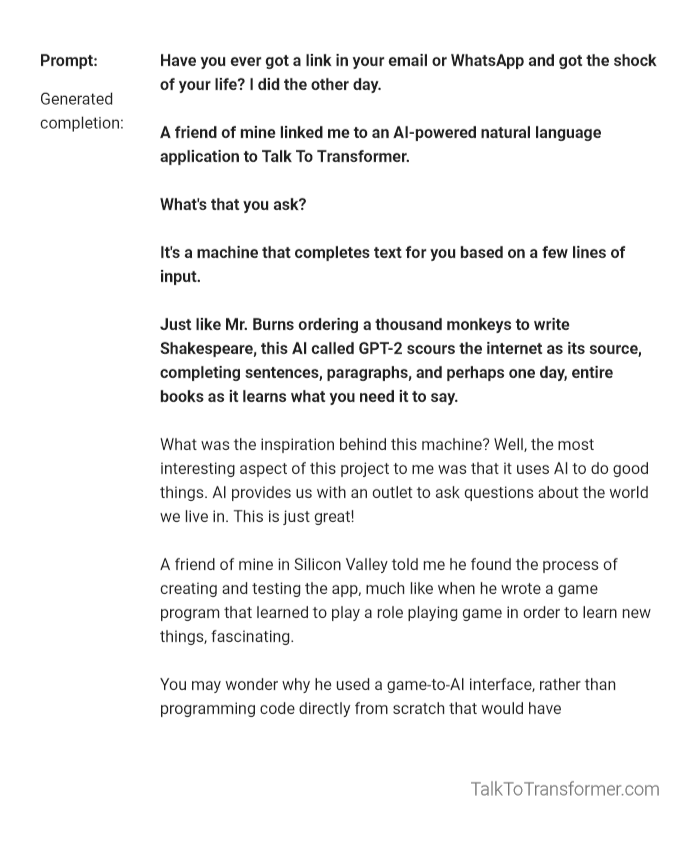
As for what Talk To Transformer came up with as an alternative to this post, see below.

talktotransformer.png

My First Piece, All Over Again

When I first started out in journalism, my first ever piece was published in Buzz Magazine, the "biggest" street press in South-East Australia (it asked you to take out a ruler and measure.) I remember holding it in my hands, proud as a father taking home his newborn. Of course, as time marched on, the afterglow of publication dimmed. (When you're an editor, you sell the dark lightbulb for ad space.)

I'm chuffed to say I experienced it again over the weekend, as Pascall published a social post I helped create (the post ideas and action copy) for their Better Together campaign. It was a lot of fun to make with the entire Online Circle Digital team - I'm so grateful for my time there and how it turned out! See it below:

Rely on friends to warm up your winter moments. Get cosy with our delicious duo - Pascall Marshmallows and Cadbury Hot Chocolate! #Pascall #Cadbury #lollies #NewZealand #BetterTogether

12 Likes, 1 Comments - Pascall (@pascalllollies) on Instagram: "Rely on friends to warm up your winter moments. Get cosy with our delicious duo - Pascall..."

Drawing Attention: Script for Animated Ad!

Just a short note to showcase this awesome new ad for my friends (and by my friends) at the Animation Company.

Sam and the Animation Company are one of my dearest clients, and I was lucky enough to help write the script for this short attention grabber. I was especially proud of the tagline I came up with - keep an ear out for it!

The Animation Company is a Sydney based corporate and business oriented animation studio. They're always creating engaging, informative and attention-grabbing animation in both 2D and 3D.

To find out more about the Animation Company (with website copy by me!), click here.