How to Become a Copywriter

People often ask me how I became a copywriter in the first place. I half-jokingly say that I “printed up a bunch of business cards, put my name on them, then added ‘copywriter’ underneath.”

It’s a bit of an oversimplification, but that’s essentially how I began my business as a freelance copywriter.

There is no standard definition of “copywriter.” A technical copywriter may focus on documentation and processes, while a creative copywriter writes for marketing and advertising purposes. More on that in my blog about technical vs. creative copywriting here.

There exists copywriters who write exclusively for advertising; others that write direct response or sales letters; some are website copywriters, who may also be called “content writers” interchangeably.

If you are thinking about becoming a copywriter as a career, here are some things to consider.

How Do I Become A Copywriter With No Experience?

Unlike other jobs, copywriting is a profession with a low barrier of entry – copywriting is not regulated, nor is it self-regulated or gate-kept by a guild or union. Anyone with an internet connection and a laptop can set up a website or register for a job board such as Upwork or Fiverr and ply their trade.

Training as a copywriter isn’t standardised, nor is it essential. You can read books about copywriting and attempt to emulate the greats such as David Ogilvy or Dan Kennedy. If you have a good – and I mean being in the top ten to five percent of the population - command of English (or your home language) you can “make it” as a copywriter.

Basic Copywriting Skills

The main suite of skills you’ll need to be a copywriter are:

  • Written communication

  • Creativity or lateral thinking

  • Problem solving

  • Oral communication

  • Time management

  • Editing

  • Business management - if you are going freelance

Studying some type of business finance or management is essential. I recommend the Finance Academy course Managing Business Finance by Chinmay Ananda to get you up to speed.

The Academic Route

In Australia, if you absolutely love learning in an academic setting (and I did), you could study a Bachelor of Arts concentrating in English or Media and Communication. A Bachelor of Business or a Bachelor of Commerce in Marketing may also include units on copywriting.

However, if you find you need to hone your skills without spending thousands of dollars (and hours) at university, I personally recommend you study a Certificate IV in Professional Writing and Editing. This teaches you the fundamentals of written English communication in a work context.

How Do I Start Out As A Copywriter?

If you have your heart set on copywriting as a career, try to apply for as much work experience as you can at your high school or TAFE. Try to get work experience at as many types of agencies or houses as possible – advertising agencies, marketing firms, content writing houses, communications, or PR agencies – so you get a feel for what type of copywriting and editing you are strong at; and what needs work.

In this work context, you should also be able to work to tight deadlines and confusing, sometimes contradictory briefs. You’ll also learn not to take criticism personally and learn from your mistakes. Letting go of attachment to your work is also a must; in the content writing world especially, you are giving voice to someone else!

While talent and experience are essential, or even just the willingness to learn, having the right tools can make your journey much smoother. You do not need an elaborate setup to get started; a reliable laptop, a comfortable home office space, and a stable internet connection will often cover the basics. As your career grows, you can invest in software for project management, grammar checking, and collaboration, but in the beginning, a simple, organised workspace is often all you need to start producing great work.

The Advertising Advertising Paradox

As mentioned before, the barrier to entry for a copywriter is low. You ideally need a website to show off your portfolio and act as a lead magnet. If you don’t have a portfolio, approach friends and family and offer to refresh their resumes or websites for them.

However, you need to write ads that not only advertise your proficiency as a copywriter, but act as a “free sample” of your work for other businesses. If it can convince them, chances are you can convince their audience their product or service is worth buying too.

DO. NOT. WORK. FOR. FREE.

Because you are just starting out, you will be tempted by offers from start-ups or ne’er-do-wells asking you to work for “exposure.”

Ignore these people. They are choosing beggars at the very least.

Working for free is not only illegal in Australia, but it also makes it worse for everyone else in the industry.

The number of emails I get saying “I’ll get my cousin/friend/best mate’s brother’s wife to do it for free” would make the average person blush. I simply tell them – if they’re so good, why are you bothering me?

A 400-word blog post may take me 20 minutes to write. However, just like the mechanic who knows exactly where to strike his tiny hammer to fix a car in five seconds – you’re not paying for my time, you’re paying for my expertise.

Even if you hit up family and friends for work, set a price. A junior, fresh out of uni/TAFE/beginner should be able to earn $25-30/hr if they can demonstrate a good level of professionalism and proficiency.

As I always say, be “uneditable” - the less work you make for editors, the more you jobs you’re picked for.

With all that in mind, will you make copywriting your career?


Want to know more? Want a professional to write your copy and content? Get award-winning copywriting from I Sell Words.


Working from home? The freelancer’s guide to staying sane and being productive

Today marks my 1542nd day of self-isolation. I’m not sick or anything. Unless you count full-time freelancing as an illness of the mind.

As much as I love freelancing, it isn’t for everyone. I’m a natural born introvert (and some say, misanthrope) and am most energised when I’m writing instead of talking.

Others are the opposite. I get that too.

So here are some ways to stay sane and be productive at the same time – both of which go hand in hand.

“This is my fifteenth cup of coffee and I’m still not done reorganising my folders.”

“This is my fifteenth cup of coffee and I’m still not done reorganising my folders.”

1.       Be at your desk when you’re meant to

This one is a crucial one. It establishes a routine which you can follow. If you usually start work at 9am, be at your desk at 9am. Even if it is just a shuffle from your bedroom to your new ersatz office setup. Which it should be: don’t work in pyjamas from your bedroom.

If you work from a desk, set up a desk, even if it’s at your kitchen table. Ensure a continuity of your habits at your home. If you sit in a beanbag at work…why?

2.       You’re still on company time – remember that

The urge to watch YouTube and play video games on your computer with 1440p screen and GTX 1070 graphics card can overwhelm you at times; but that’s not why you’re at your desk. A quick round of Battlefield 1 or side quest of Kingdom Come: Deliverance may not hurt anyone, but you’re being paid to sit there. Honour the commitment. Play games during your lunch break, or better yet, after knockoff time.

Don’t disappear from your desk for long stretches without explanation. You wouldn’t do it at work, so don’t do it here.

3.       Lonely? Use talking heads in the background

Hungarian-American author and psychologist Mihaly Csikszentmihalyi said that every human being can enter a state of “flow” or effortless connectedness to their work, brought on by setting goals and devoting oneself to a challenge. You’ve felt it before when you felt “in the zone” or “switched on.” This means your brain is allocating mental resources to the task above all others.

However, as our brains want to do, ruminate. Some of us feel anxiety when we are isolated. (I’m not one of them. Then again, I’m weird.)

In order to regulate your mental resources and flow state, it’s helpful to have familiar noise in the background such as human voices. They aren’t substitute for the real thing when you’re concentrated on it but will suffice when you’re in a “flow” state. No, I don’t recommend the news at the moment.

I recommend death metal at ear-splitting volume, but that’s just me.

4.       Stop eating everything

Seriously, stop that. Don’t order in. Make your own stuff. It’s not only better for you, it’s cheaper. My coffee bill is about $15 per month, because I make my own using a drip filter. Most office working people hit that in about two days.

Go for walks in the afternoon, too. Keep up your gym routine – this is just as important for your mental health as much as it is your physical health.

5.      Do your job and do it right

The temptation to do your job half-assed unsupervised is tremendous; but character is what you are in the dark and who you are behind a screen when no-one (you know of) is looking.

Sir Henry Royce said “whatever is rightly done, however humble, is noble.”

I also say that adulthood is the feeling when, as a kid, you clean your room from top to bottom and your parents (who usually bug you about it) don’t even notice. You do what must be done because it must be done. The mature person does not lust after praise.

In these trying times, hard work, honesty, and helping others are the three elements that will ensure we bring out the best in ourselves and each other.

Let’s get to work.

Everybody's Doing It, Why Not You?

If you've stepped outside since October, it's beginning to feel a lot like Christmas.

What that actually means to you is as various as people in general. It could mean dragging plastic trees around the house; spending up big and forgetting it until your statement arrives; or you could be of a faith that only observes this bizarre ritual at a distance.

The language of Christmas - and likewise the language of anti-consumerist sentiments in opposition to it - are quite similar. They both try to persuade people into adopting a tradition that only dates back a couple of generations. Christmas as the gift-swapping, Turkey-engorged ritual we observe every 25th of December is as "made up" as Halloween; though detractors of the former will happily embrace the latter.

Many "traditions" are what we'd refer to today as "viral marketing campaigns"; the DeBeers diamond cartel insisting men save up at least 'three months salary' to buy their fiance an engagement ring with a diamond encrusted on top. That was dreamed up by the N.W. Ayer ad agency in the 1900s, to prop up what was once an abundant and intrinsically worthless gemstone.

We as humans (seem to) need ritual, repetition. It feels safe, and it feels predictable. If we arrived home after work each night and our keys worked one time in ten, we'd feel pretty out of sorts. Marketing and advertising around Christmas often depicts the familiar and cozy - even though a snow-driven Christmas is largely a product of the American imagination. Our drink containers, wrapping paper - even Christmas crackers - all show us images of Snowmen, candy canes, and hot cups of cocoa. All this in the middle of blazing summer, on a continent far removed from the frosted-over driveways of Europe or the United States.

Even as absurd as it sounds, this holiday has near universal support. Is that a good thing? Like most decisions we make in life, that's up to us and us alone. It's a weird one, when you think about it!

Here's my pitch and sizzle reel

Well, not quite. But the great friends at Bizividz recorded a great promo video for my upcoming seminar on Monday, 9 May at Sandringham Yacht Club. Click here to register!

To talk copywriting (accounting...website development and everything else) you're always welcome to come along to one of Bayside Business Network's networking nights at the beautiful Royal Melbourne Golf Club in Sandringham. It's on Wednesday, the 4th of May. Click here for more information!

A Word Sparking Star Wars and Real Wars

A Word Sparking Star Wars and Real Wars

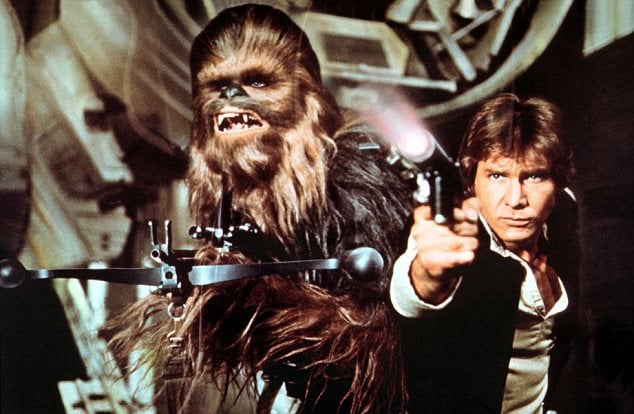
Star Wars: The Force Awakens drowned us this summer, with merchandising ranging from mascara to oranges on store shelves. Once I saw the new film, I wanted to see the original theatrical versions, undiluted by George Lucas’ meddling. Lucasfilm insists they no longer exist. Of course, legions of fans took it upon themselves to reconstruct the films using a variety of sources. The most controversial change in the first film takes place in the Mos Eisley cantina scene. (spoiler alert – but really, you should’ve seen Star Wars by now!) Green gilled and bug-eyed Greedo corners smuggler Han Solo. Han’s a marked man and Greedo’s itching to collect. In the original version, (after stalling and Han drawing his blaster) Han shoots Greedo “in cold blood.” Here’s what the shooting script says:

“Suddenly the slimy alien disappears in a blinding flash of light.  Han pulls his smoking gun from beneath the table as the other patrons look on in bemused amazement.”

Later revisions show Greedo shooting first, then Han and Greedo shooting at the same time. “So what?” you might think. This visually insignificant change is one that contains multitudes.

It’s supposed to inform viewers that Solo isn’t so trustworthy. Ben and Luke have put in their lot with this low-life braggart. We’re supposed to feel uneasy about this hasty alliance. It changes the tenor of the film. Han could have sold Ben and Luke if captured by the Imperials, left them for dead at any time, etc.

Another far more tragic example of subtle changes having long reaching effects was during the last gasp of World War II. Japan, threatened by invasion from the United States and fast running out of resources, was determined to fight until the last man. The “Big Three” (United Kingdom, Soviet Union and the US) issued an ultimatum for surrender to the Japanese. The Japanese responded in the negative, but suffered from mistranslation. A word – mokusatsu – has two meanings in Japanese. The first being “ignore” and the other, “refrain from comment.” It was the difference between “let us think about it” and “We refuse!” If the message was translated as “no comment,” the Japanese and US may have arrived at a surrender deal, preventing the twin atomic horrors of Hiroshima and Nagasaki. This misinterpretation struck consequences far beyond the imaginations of its writers and readers.

It’s a chilling lesson for clarity and precision in communication. We may think that subtle differences make no difference, although we're proven wrong time and time again. If you believe that words are your ally, do – keep in mind words might turn on you without provocation. Remember always: "Expect to misunderstand and expect to be misunderstood."