
How to Drive More Business to Your Site

In business, you need customers. To get those customers, they need to have access. To provide them access, they need to be able to find you easily. While all of this may seem extremely elementary in terms of business strategy and implementation, it can actually become quite difficult to achieve. This quandary applies both to brick-and-mortar establishments and company websites. Continue reading for some tried and true tips that will help you drive traffic to your sites and bring in more business at the same time.

Pay Attention to Driving Traffic Patterns and Ease of Access

If you are constructing a new office building or company campus in a newly developed area of your community, you will need to conduct a traffic impact assessment. Your local municipality or city will generally require this, and even if they do not, it is a good idea to take this on yourself. Hire a professional assessment company to ensure everything is done right. They have the skills and experience to understand the nuances of traffic patterns, the potential for environmental impact on the surrounding areas, and the variety of traffic needs that your new building will require, such as access roads, turn lanes, and traffic lights, to name but a few.

Ease of access to your new company site is essential for continued success and growth. If your employees have a difficult time coming to the new location and returning home each day, this will place an undue burden on their private lives and increase their fuel expenditures. None of this equates to a happy work life. They may begin looking for other employment opportunities. If your valuable customers and clients find themselves in a similar situation, all it will take is a few quick online queries, and they will likely take their business and money elsewhere. Those are just some of the reasons why conducting a traffic impact assessment is so important, beyond the obvious governmental requirements.

Assess Your Online Presence

One of the best ways to drive more traffic to your site, your website, that is, is to start by conducting an audit on the website itself. Look for broken links and relevant content. Pay special attention to on-page and off-page optimisation opportunities, as well.

A significant part of your website audit should include assessing the look, feel, and functionality of the website. Pretend you are a first-time visitor looking for information. Determine whether the contact information and the navigation hamburger are easy to find. If not, those must be remedied. Users do not want to search for things they should have easy access to. Next, take notice of the clarity of the website. Are the images too noisy and overwhelming? Do they reflect your brand well, or are they loud and outdated? Look at the background images and colour schemes. You want them to blend in seamlessly while enhancing the sight without interfering with the content.

Finally, inspect your company’s search query rankings. You want to always populate at the top of page one of a query. Work with a reputable company to create better SEO and conversion opportunities and bring more people to your site through engaging content.

Driving more business to your company’s respective sites is a lifeline. Work to ensure ease of access for on-site visitors and website users to keep growing your company.

Have I Become Obsolete? (and other fun)

Have you ever got a link in your email or WhatsApp and got the shock of your life? I did the other day.

A friend of mine linked me to an AI-powered natural language application to Talk To Transformer.

What's that you ask?

It's a machine that completes text for you based on a few lines of input.

Just like The Simpsons archvillain Mr. Burns ordering a thousand monkeys to write the best novel in history, this AI called GPT-2 works on kind of the same principle. It scours the internet as its source, completing sentences, paragraphs, and perhaps one day, entire books as it learns what you need it to say.

It predicts the next word one might have said, much like a predictive text application in your smartphone.

Despite the occasional "Sorry honey, running late for yogurt tonight", machine generated language is not new. Last year, Facebook's own AI developed its own internal language without user intervention.

Australia's very own ReporterMate, an AI-driven journalism program, spat out this article about political donations prior to the Federal Election for The Guardian. The Associated Press also uses AI to help assist reporters with articles.

So it's off to the trash heap for me! Well, not quite.

There may be a time when a machine will write better than I could ever hope to.

I don't think that time is now.

Humans using machines as tools or extensions of ourselves will become more complex and more useful. Perhaps language generators such as these will automate some tasks such as modifying legal boilerplate or updating business information.

I'm not running scared yet; but I am fascinated to see what lies ahead.

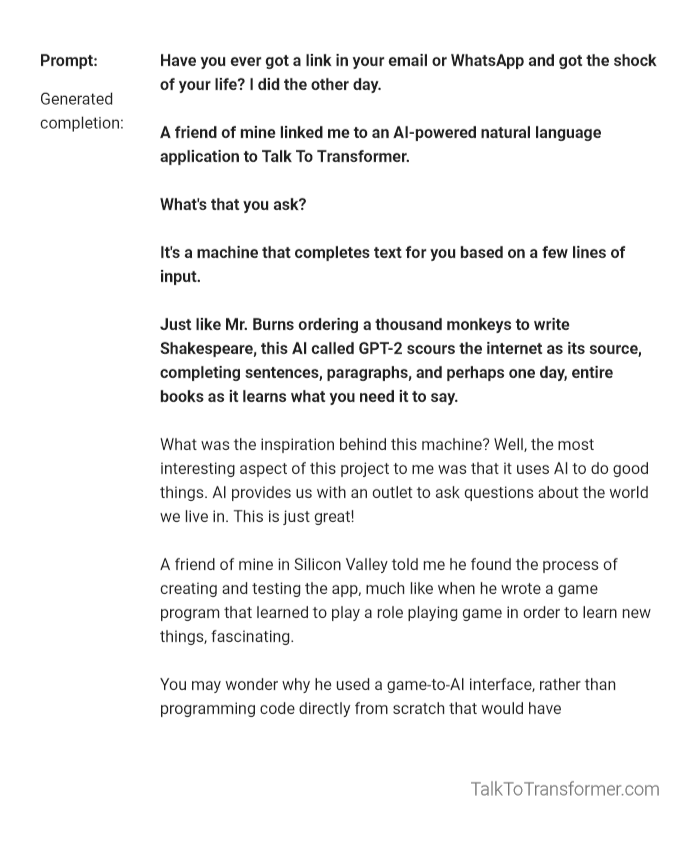
As for what Talk To Transformer came up with as an alternative to this post, see below.

talktotransformer.png

Why being someone’s “my” is the ultimate business referral

Imagine this scenario. You’re at the gym with your good friend, and you wince as you get up from a particularly gnarly stretch. Grabbing your back, your friend tells you, “You should see my chiropractor. She’s great.”

Of course, your friend hasn’t captured this hapless medical professional and stored her in the attic, just in case. But the language around who we trust with our business is that of ownership.

Owning our opinions, choices, and mistakes is an integral part of maturity. It is one reason “I” statements demonstrate that willingness to “own our shit.” 

Owning whom we place our sacred trust in is vital to our business experience.

Read more at Flying Solo.

Why every soloist should journal

Dear Diary, I feel a bit nervous telling everyone about writing in you. What if they laugh at me? What if they think I’m being precious? Worst of all, what if they ignore me?!

Well, at least I got it out there. I tried my best. That’s all that matters.

Journalling is a time-honoured tradition. So many people that shaped the world jotted down their thoughts for the day, every day (or close enough to it.): Albert Einstein, Marie Curie, Alexis de Toqueville, George S. Patton, Charles Darwin, Thomas Edison, George Lucas, Alfred Deakin, Teddy Roosevelt. That’s some great company, there. Research even tells us that outstanding leadership requires insight, and writing a journal can help achieve that.

That’s not to say journalling will spur you to instant success, of course. But it does give you pause to reflect, analyse, and process where you are and where you’d like to go.

Read the entire post on Flying Solo.