
My thoughts on how to come up with a good brand name.
Read moreHow to deal with the business ghoster

Image by Peter H from Pixabay
We’ve all been there. The emails, texts, and calls just stop from a promising business lead. We’ve been professionally “ghosted.” How can we cope and how can we prevent it from happening again?
Read moreAre You Eating Record Sales Pie This Christmas?

Source: Australia Post
Admit it - you gifted yourself a bunch of "presents" during lockdown, because reasons.
As it turns out, so did everyone else. eCommerce growth is showing signs of normalisation. Retail is so 2019. People are buying items and goods sight unseen from online shopping sites.
Australia Post figures that 2020 will be the biggest year on record for online sales. They're expecting the peak to reach over 30% over last year.
Last year we spent about $28.6 billion on online shopping. 30% more than that...well, that's a lot. If I knew how to do maths, I'd tell you. Lucky for all of us, I'm a copywriter, not a mathematician.
So how are you going to get a slice of the record sales pie this Christmas - and eat it too?
We're only 29 days out from Christmas (I know, right?) and if you aren't ramping up your marketing and mailouts, there's not that much time left.
Sending electronic direct mail (eDM) helps your audience recall your brand more often - 74% more according to research - and being impossible to ignore is the aim of the game this Christmas.
If you need help with eDM, content, or a strategy for this Christmas (and New Year) I Sell Words is open until the 21st of December - and I'll be re-opening on the 6th of January, 2021. Drop me a line!
If You Can Interview, You Can Negotiate

Fig. 1: Ancient friendship and agreement ritual (c. 2019 C.E.)
Up until earlier this year, I worked as a music journalist and editor. I spent about nine years at Hysteria Mag, the last few of which as an Editor of some kind. One of the most enjoyable aspects of the job was the rock star interview.
I’d done about 300+ interviews in my time for a range of publications. I conducted about 95% of these interviews over the phone. These interviews are given out in “slots.”
Journalists and broadcasters are invited to join a one to two-hour block of interviews, with each interviewer given a 15 to 20-minute allocation to talk to the muso.
This was all an exercise in PR and promotion for a new album or tour. About 90% of interviews were about an upcoming album, tour, or both. It was rare to interview a subject “just because.” It had to be during “promotion season” or not at all.
As a greenhorn, I would ask obvious questions. How was it recording this time around? Are you excited to go on tour? Did the new member contribute well? Are you going to have X and Y on the set list?
Woe betide the scribe who hit their subject with generic questions like this at the end of a two hour block. At best you’d get annoyed, one- or two-word answers as they’d been asked the question about six times already.
Sometimes, musos just didn’t much care for doing media. They were strongarmed into it by their PR or record company. At the end of the day, it was like they were being treated like a sponge, each interviewer wringing more and more out of them, even though their mental bandwidth had long since evaporated.
“With apologies to Joel Saltzman who said “if you can talk you can write,” it would seem “if you can interview, you can negotiate.”
In computing, Garbage In Garbage Out means that if you put in erroneous data you’ll get unreliable results. The same goes for interviewing. Ask boring questions, get boring answers. I wanted to make this my career one day (my advice for kids doing it now: don’t) so I had to up my game.
Through trial and error, I hit upon the magic words that signalled a great interview. The interviewer either had to respond with something like:
“That’s a great question.”
Or
“Yes, you’re right.”
The setup to these questions is usually closed, not open ended. For example, interviewing one of my favourite subjects; multi-instrumentalist, and wide-eyed dreamer Devin Townsend, I asked:
“Would you say that you’re a person that sort of craves varied stimulation? I mean this in a creative sense, where doing that same thing will lead to an inevitable inertia, stagnation.”
He replied with “a hundred percent, a hundred percent.” Devin is not a particularly hard subject to interview. The fact that I connected with him on a level that made him heard, not just a resource, allowed me to probe further and ask more personal questions than if I didn’t have him on side.
Not everyone is an interviewer by trade, but we do communicate with people in the same way. In business, we use the euphemism “job interview” as part of the selection process for an open position. In other terms, a person negotiates their way to getting the job. He or she must convince the boss or hiring manager that they are the right person.
Reading and watching videos on Never Split The Difference: How To Negotiate As If Your Life Depended On It by Chris Voss, a former FBI hostage negotiator, finding an empathetic common ground often leads to a successful negotiation where you concede little, perhaps none, of your position.
He calls this “tactical empathy.” I used to call it “good interview technique.”
With apologies to Joel Saltzman who said “if you can talk you can write,” it would seem “if you can interview, you can negotiate.”
In an interview, the subject has information that a journalist wants to gain. Some interviewees, especially in general news or politics, do not want to give up that information so easily. Gaining the trust of a subject can be a tricky business, especially if they are survivors of a traumatic event.
We all know what it feels like to be heard and empathised with. We all know how it feels to have a conversation where both parties get to know one another. Most things in life are negotiated in a broad sense; a romantic date is a negotiation in some respects, as both parties put their best qualities forward to find love or companionship.
It would seem that “Getting to Yes” (a great book on negotiation) is as important to achieving the empathetic “Getting to ‘You’re Right.’”
Interviewing is a learned skill, like writing is a learned skill. Mathematics is too (still working on that, let me tell you.) It would seem the calculus of a successful negotiation is simply applied listening and empathising.
It might lead to less stress and a greater understanding of our needs. I think it’s definitely something we’re all craving at the moment.
Support For Business During Coronavirus Disease (COVID-19) Pandemic
It’s tough for business at the moment. We’ve all felt the pinch and will do for months to come.
It’s imperative that we band together and survive this crisis so we can make the most of the recovery that lies ahead.
As such, I'm offering half-rates for consulting, editing, and proofreading during the crisis through to May.
This is helpful if you need a "sanity check" or additional research to ensure your communications are clear, compassionate, and free of errors. The spread of disinformation is something all of us want to avoid.
I'm also offering 25% off copywriting for new website pages and product descriptions, helpful for businesses transitioning from a face-to-face operation to online.
As always, half-rates apply to not-for-profit organisations and/or community organisations for all work.
Last, I have special codes for two months free Skillshare, where you can take my course on better business writing.
Skillshare is a platform where you can learn new skills around almost anything you can think of: writing, photography, web design, crafts - you name it. (If you've seen a YouTube video in the last few months, you've probably heard of it!) Just email me and I'll send you the link.
If you need a hand or are willing to lend a hand, I urge you all to sign up to crisisheroes.com.
Stay strong,
Tom
Working from home? The freelancer’s guide to staying sane and being productive
Today marks my 1542nd day of self-isolation. I’m not sick or anything. Unless you count full-time freelancing as an illness of the mind.
As much as I love freelancing, it isn’t for everyone. I’m a natural born introvert (and some say, misanthrope) and am most energised when I’m writing instead of talking.
Others are the opposite. I get that too.
So here are some ways to stay sane and be productive at the same time – both of which go hand in hand.

“This is my fifteenth cup of coffee and I’m still not done reorganising my folders.”
1. Be at your desk when you’re meant to
This one is a crucial one. It establishes a routine which you can follow. If you usually start work at 9am, be at your desk at 9am. Even if it is just a shuffle from your bedroom to your new ersatz office setup. Which it should be: don’t work in pyjamas from your bedroom.
If you work from a desk, set up a desk, even if it’s at your kitchen table. Ensure a continuity of your habits at your home. If you sit in a beanbag at work…why?
2. You’re still on company time – remember that
The urge to watch YouTube and play video games on your computer with 1440p screen and GTX 1070 graphics card can overwhelm you at times; but that’s not why you’re at your desk. A quick round of Battlefield 1 or side quest of Kingdom Come: Deliverance may not hurt anyone, but you’re being paid to sit there. Honour the commitment. Play games during your lunch break, or better yet, after knockoff time.
Don’t disappear from your desk for long stretches without explanation. You wouldn’t do it at work, so don’t do it here.
3. Lonely? Use talking heads in the background
Hungarian-American author and psychologist Mihaly Csikszentmihalyi said that every human being can enter a state of “flow” or effortless connectedness to their work, brought on by setting goals and devoting oneself to a challenge. You’ve felt it before when you felt “in the zone” or “switched on.” This means your brain is allocating mental resources to the task above all others.
However, as our brains want to do, ruminate. Some of us feel anxiety when we are isolated. (I’m not one of them. Then again, I’m weird.)
In order to regulate your mental resources and flow state, it’s helpful to have familiar noise in the background such as human voices. They aren’t substitute for the real thing when you’re concentrated on it but will suffice when you’re in a “flow” state. No, I don’t recommend the news at the moment.
I recommend death metal at ear-splitting volume, but that’s just me.
4. Stop eating everything
Seriously, stop that. Don’t order in. Make your own stuff. It’s not only better for you, it’s cheaper. My coffee bill is about $15 per month, because I make my own using a drip filter. Most office working people hit that in about two days.
Go for walks in the afternoon, too. Keep up your gym routine – this is just as important for your mental health as much as it is your physical health.
5. Do your job and do it right
The temptation to do your job half-assed unsupervised is tremendous; but character is what you are in the dark and who you are behind a screen when no-one (you know of) is looking.
Sir Henry Royce said “whatever is rightly done, however humble, is noble.”
I also say that adulthood is the feeling when, as a kid, you clean your room from top to bottom and your parents (who usually bug you about it) don’t even notice. You do what must be done because it must be done. The mature person does not lust after praise.
In these trying times, hard work, honesty, and helping others are the three elements that will ensure we bring out the best in ourselves and each other.
Let’s get to work.
Three Tips To Improve Your Writing
Clients and friends come to me asking about how they can improve their writing? I say that clarity and concision is the best way to communicate. To start with, concentrate on these three things:
1. Read examples
2. Edit yourself
3. Swimmers swim, writers write.
Here is a short video discussing these tips. Got tips of your own? Comment below!
Camera by Dave Kenyon
Machines Using Humans To Make Better Machines

A machine improving itself using a human, we figure.
While browsing social media, have you ever encountered something that made you just so angry you couldn't stand it? Well, that's a feature, not a bug. As media theorist Douglas Rushkoff states:
“Researchers have found, for example, that the algorithms running social media platforms tend to show pictures of ex-lovers having fun. No, users don’t want to see such images. But, through trial and error, algorithms have discovered showing pictures of our exes having fun increases our engagement. We are drawn to click on those pictures and see what our exes are up to, and we’re more likely to do it if we’re jealous they’ve found a new partner. The algorithms don’t know why it works, and they don’t care. They’re only maximise whatever metric we’ve instructed them to pursue.”
- Douglas Rushkoff, Team Human
It struck me how far we've come from the 1950s, when Norbert Weiner's theory of cybernetics - humans using machines to improve humans - has turned itself on its head. We're now using machines to exploit humans to refine the machines. We can either program (the insidious "learn to code" meme) or be programmed.
The machines are trying their best to remove us from the human equation. We have metrics, dashboards, bounce rates, pageviews, conversions; some of us talk in this machine language that would've made Dr. Weiner's head spin. We're trying to be like computers, but we can't. A computer has perfect memory, perfect algorithms, perfect recall. It can know you better than you know yourself.
Unfortunately we cannot go back to a previous time; you can't cut smartphones or the Internet out from our culture; no more than you can remove your liver or lungs. It's transformed our entire society, whether we like it or not.
In French sociologist Jacques Ellul’s view, the bargain we make with new technology is Faustian; what problems new technology solves seems to take something away at the same time.
I remember a time when I used to (well, still do) blow up innocent pixels in flight simulators and first person shooters. My Dad couldn't understand the unrestrained glee I was having, using (simulated) weapons of mass destruction.
I said these disintegrated people weren't "real." Instead, "they" were computer-generated characters programmed to fight me and die trying. We can obviously distinguish between what's real and what's not (though deepfakes and other misinformation might muddy those already hazardous waters), but when we end up serving machines, we often lose sight of the human element.
Often, clients become folders, deadlines, and metrics. They're no longer people with struggles of their own, reaching out to me for help with something. I think in the PPC, CPC, "machine" algorithm age, many of us don't take the time to value a client for who he or she is.
A computer can't really recognise the value of something unless we tell it to.
We can.
It's hard, but I think it's worth doing.
Leaders Are Not Our Masters

Seneca The Younger, Stoic Philosopher. (4 BC - 65 CE)
“A man who follows someone else not only does not find anything, he is not even looking. But surely you are going to walk in your predecessors footsteps? Yes indeed, I shall use the old road, but if I find a shorter and easier one I shall open it up. The men who pioneered the old routes are leaders, not our masters. Truth lies open to everyone. There has yet to be a monopoly of truth. And there is plenty of it left for future generations too.”
The world of words we inhabit is so continuous and ever-changing, it is near inseparable from the world of non-words, or things. Sometimes we call this reality. Reality, as author Philip K. Dick defines it, is the “part of life that doesn’t go away when you stop believing in it.” It was this I was pondering when reading Seneca’s Letters from a Stoic the other day. Leaders are made, not born. They are believed in, which gives them their power.
Mastery over others can follow leadership, this is true. The charisma and cunning of leaders throughout history have moved nations into greatness; others have led them straight into a firing line. Once we have accepted someone as leader and master, is there any resolve left to carve our own path? Can we all be leaders? Can we be leaders without being masters?
In my previous blog on mastery, I talked about mastery as the command of a subject or process to it’s highest degree, not mastery as a person having dominion over others. The dominion is a voluntary process; there is no natural law that decrees one person having control over another, at least not in this day and age. Leaders as Masters may use rhetoric, “fear, uncertainty, and doubt” and other tricks to get others under their thumb. Living in a “post-truth” world, they purport to have a monopoly on truth, the same monopoly Seneca denies to any one person.
In business, some think of “leadership” as “mastery” - that they are the boss, they know better, and others should do what they say. This is not leadership, let alone mastery. Mastery, as I discussed earlier, is the attitude that one has achieved so much that there is nothing more to be learned. This too is folly.
I think that leaders can be learned from. Leaders who have both succeeded and failed in their pursuits are excellent learning tools. They led the way into a new market, a new field of study, a new path; and right now is the time we push the frontier of what’s unknown back a little more.
As humans, we are the only creatures we know of that bind time; that is, project our knowledge into the future through our children and (hopefully) build upon it. This is what Seneca means by “there is plenty left for future generations.” Their chase for wisdom has only just begun, and may teach us something in the process.
When I see “thought leaders” and “business leaders” in print, my mind turns to the “mastery” definition of leaders - that they must have followers to be leaders. I don’t think that definition, at least for me, cuts it any more. Perhaps we should think of leaders as those who got their first, or those who are trying something new, or those who speak truth when it falls on deaf ears. Leaders need not be sitting atop piles of riches to be leaders. Military leaders can charge into battle and be forced to retreat. In the absence of anyone willing, leadership appears when someone says “I’ll do it.”
All can be leaders, if we live in accordance with nature; that is, seek truth and concern ourselves with “what is going on” instead of “what’s inside our heads.” Following the majority will lead to mediocrity after all, as Seneca once wrote in his Letters.
Leaders only have mastery over us if we give it to them.
Was Obi-Wan ever a "Master?"

Obi-Wan Kenobi preparing for battle in Star Wars.
If you haven't seen Star Wars by now, I have to question your parents' devotion to you and whether you had a childhood at all. (This is my way of telling you there's spoilers.)
Anyway...
In the first Star Wars film (I refuse to retroactively call it A New Hope), Jedi Master Obi-Wan Kenobi sacrifices himself facing former pupil Darth Vader, allowing Luke Skywalker and his friends to escape the Death Star. In Star Wars lore, the master in Jedi master owes more to a Jedi Knight taking on an apprentice and showing him or her the ways of the light side of the Force.
The word mastery denotes control and supreme knowledge. It connotes having a thorough command of a subject or process, something "one could do in their sleep."
Last month, I had some time with a good friend Earl Livings, who himself is a writing teacher and fiction author. I had shown him the fourth draft of a short story I'd written back in January. He gave me some praise; however the markings, corrections, and suggestions told me I was a long way from "mastering" anything.
Was Obi-Wan really a master? Or was he in the process of learning too? He made a few blunders by withholding from Luke the true nature of his father.
Of course, failure is always feedback. Each red line through my prose is another step towards "mastery," though attainment of such a state may always be another step ahead, no matter how far I travel. I don't feel that the skills that comprise one's profession requires complete "mastery" as there is always more to learn.
I always fear the person who says they are complete in their knowledge; as this is rarely mastery at all.
Do you feel like you need to "master" subjects or skills? Or are you always a work in progress, like me?
Let me know in the comments below.
Have I Become Obsolete? (and other fun)
Have you ever got a link in your email or WhatsApp and got the shock of your life? I did the other day.
A friend of mine linked me to an AI-powered natural language application to Talk To Transformer.
What's that you ask?
It's a machine that completes text for you based on a few lines of input.
Just like The Simpsons archvillain Mr. Burns ordering a thousand monkeys to write the best novel in history, this AI called GPT-2 works on kind of the same principle. It scours the internet as its source, completing sentences, paragraphs, and perhaps one day, entire books as it learns what you need it to say.
It predicts the next word one might have said, much like a predictive text application in your smartphone.
Despite the occasional "Sorry honey, running late for yogurt tonight", machine generated language is not new. Last year, Facebook's own AI developed its own internal language without user intervention.
Australia's very own ReporterMate, an AI-driven journalism program, spat out this article about political donations prior to the Federal Election for The Guardian. The Associated Press also uses AI to help assist reporters with articles.
So it's off to the trash heap for me! Well, not quite.
There may be a time when a machine will write better than I could ever hope to.
I don't think that time is now.
Humans using machines as tools or extensions of ourselves will become more complex and more useful. Perhaps language generators such as these will automate some tasks such as modifying legal boilerplate or updating business information.
I'm not running scared yet; but I am fascinated to see what lies ahead.
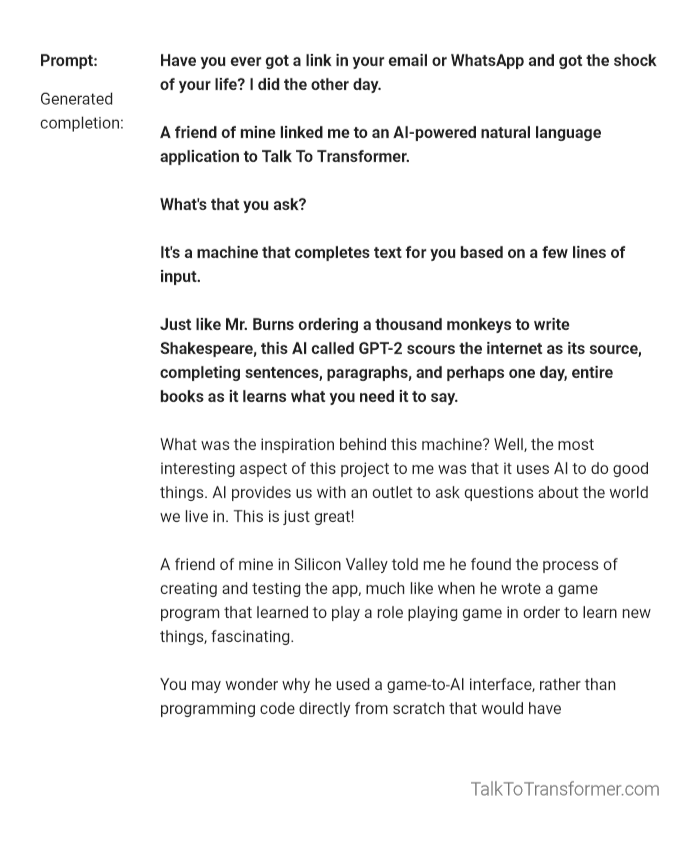
As for what Talk To Transformer came up with as an alternative to this post, see below.
Default - The two bitterest words in the English language

Homer Simpson winning the NASA astronaut contest by default. Courtesy Frinkiac
Last year, I was pitted against a client turned enemy - someone I’d trusted until one day…he simply refused to pay.
Until a business owner is faced with a bad debtor, it’s hard figuring out what to do. Thanks to some help from friends, family, and the good people over at Flying Solo, I tried my hardest to recover what was owed to me.
Enter Client X
Client X, as I’ll describe him, was something of an entrepreneur himself. He had a few fingers in more than a few pies. He dabbled in marketing, lead generation, and sales of parts in the construction industry. He hired me to bolster his personal brand. This was in August of last year.
I wrote some blogs based on his opinions, which he supplied to me. He also asked me to come up with some “inspirational quotes” for his Instagram. The type successful people never post on Instagram, because they’re too busy chasing the next opportunity. I digress.
As usual, I sent my invoices out with 14 day terms.
As the 14th day arrived, I sent out a reminder. Then an overdue reminder. And another. Then another.
After about a week or two, Client X confessed he was having trouble with his own debtors. I sympathised, and suggested we work out a payment plan. He paid about 20% of the invoice and promised to pay the rest off over the next four weeks.
The payments never came.
What to do? My only real recourse was to send him a Letter of Demand. This came back “return to sender” and “no such address.” Something I didn’t expect, since I gained the details from an ASIC extract.
So I had to go down the legal route. I told Client X by way of my assistant I’d take the case before VCAT.
I did.
I won (plus the VCAT fee.)
It wasn’t enough.
He came back with a laundry list of excuses as to why he wouldn’t pay. He said the company had no assets, and all he’d be willing to give me was another 20% of what I was owed.
I told him that was unacceptable.
Enter CreditorWatch
The drama dragged on into December. I was at a wits’s end. I turned to the Flying Solo forums. Many offered a bit of camraderie, but similar head scratching. Until Tracy Fowler replied:
There are a couple of things you can do. You can list a default against him with a credit reporting agency... this will affect his credit rating for a period of 5 years whenever he goes for finance, as he is a director, it will affect his personal rating as well. You must give adequate notice of your intent to list a default... I usually send 3 emails or letters giving 7 days to respond, with the fourth contact 3 days later, and the fifth and final notice on the day I intend on listing the default. For the default, I would recommend using Creditorwatch, there is a $20 or $30 monthly fee for joining, but it gives you up to 5 credit reports, (which everyone should use prior to giving credit terms) and listing defaults are free. Creditorwatch are only for B2B transactions and the debt has to be over $150.00…
I have had debtors come back 2 years after a default and pay the debt and costs to have the default amended to paid, so that they can obtain finance. There are no guarantees, but at least it is a warning to others.
The other thing you can do is take yourself off to the local magistrates court and use the VCAT order to obtain judgement. This also stays on their credit file for 5 years, and affects their ability to obtain finance in the future.
I knew about filing defaults against individuals from my finance copywriting, but not about companies - this was golden advice.
Once I wielded the word default aloft like Excalibur, the fur started to fly.
“I’ll Sue for Deformation”
Client X was dogged in his determination to hold on to his money. When I said I’d lodge a default against his company through CreditorWatch, he was furious.
He ranted and raved that he’d sue me for “deformation” (I think he meant defamation) even though I’d dotted every “i” when it came to getting what I was owed. He said he’d get my default “removed within a day”. I retorted (perhaps cheekily) that if he had enough money to pay for a lawyer, he had enough money to pay me the full amount.
December rolled into January 2019, and I did indeed register a default against his company. This company is now in voluntary administration. Will I ever see the money? I doubt I have a Cuba Gooding, Jr. like confidence to shout it at anyone in particular.
The Lesson
Some friends asked why I just didn’t take the money and settle it. At one point, I tried. He wasn’t acting in good faith, and I rescinded the offer. He was trying to get this monkey off his back by any way possible.
What Client X owed me wasn’t a massive amount (less than $500), but it was significant. Either way, it was the principle of the thing. If I allow myself to get fleeced, have my boundaries violated, then who else might take advantage? As a solo business owner, I value my time, which is why I dare make a living off it.
I think as a professional communicator, the meta-communication in this says “If you value my product, you must also value my time - and I trade my time for money.” I hope other soloists and small business owners can learn from my experience. As frustrating as they were.
Paul from the FS forums summed it up best: “Order work, then pay for it.”
Special thanks to Tracy at BDM Credit Management for all her help and advice!
Why being someone’s “my” is the ultimate business referral
Imagine this scenario. You’re at the gym with your good friend, and you wince as you get up from a particularly gnarly stretch. Grabbing your back, your friend tells you, “You should see my chiropractor. She’s great.”
Of course, your friend hasn’t captured this hapless medical professional and stored her in the attic, just in case. But the language around who we trust with our business is that of ownership.
Owning our opinions, choices, and mistakes is an integral part of maturity. It is one reason “I” statements demonstrate that willingness to “own our shit.”
Owning whom we place our sacred trust in is vital to our business experience.
Everybody's Doing It, Why Not You?
If you've stepped outside since October, it's beginning to feel a lot like Christmas.
What that actually means to you is as various as people in general. It could mean dragging plastic trees around the house; spending up big and forgetting it until your statement arrives; or you could be of a faith that only observes this bizarre ritual at a distance.
The language of Christmas - and likewise the language of anti-consumerist sentiments in opposition to it - are quite similar. They both try to persuade people into adopting a tradition that only dates back a couple of generations. Christmas as the gift-swapping, Turkey-engorged ritual we observe every 25th of December is as "made up" as Halloween; though detractors of the former will happily embrace the latter.
Many "traditions" are what we'd refer to today as "viral marketing campaigns"; the DeBeers diamond cartel insisting men save up at least 'three months salary' to buy their fiance an engagement ring with a diamond encrusted on top. That was dreamed up by the N.W. Ayer ad agency in the 1900s, to prop up what was once an abundant and intrinsically worthless gemstone.
We as humans (seem to) need ritual, repetition. It feels safe, and it feels predictable. If we arrived home after work each night and our keys worked one time in ten, we'd feel pretty out of sorts. Marketing and advertising around Christmas often depicts the familiar and cozy - even though a snow-driven Christmas is largely a product of the American imagination. Our drink containers, wrapping paper - even Christmas crackers - all show us images of Snowmen, candy canes, and hot cups of cocoa. All this in the middle of blazing summer, on a continent far removed from the frosted-over driveways of Europe or the United States.
Even as absurd as it sounds, this holiday has near universal support. Is that a good thing? Like most decisions we make in life, that's up to us and us alone. It's a weird one, when you think about it!
Why every soloist should journal
Dear Diary, I feel a bit nervous telling everyone about writing in you. What if they laugh at me? What if they think I’m being precious? Worst of all, what if they ignore me?!
Well, at least I got it out there. I tried my best. That’s all that matters.
Journalling is a time-honoured tradition. So many people that shaped the world jotted down their thoughts for the day, every day (or close enough to it.): Albert Einstein, Marie Curie, Alexis de Toqueville, George S. Patton, Charles Darwin, Thomas Edison, George Lucas, Alfred Deakin, Teddy Roosevelt. That’s some great company, there. Research even tells us that outstanding leadership requires insight, and writing a journal can help achieve that.
That’s not to say journalling will spur you to instant success, of course. But it does give you pause to reflect, analyse, and process where you are and where you’d like to go.
Thinkpiece Marketing – is it a thing?

Childish Gambino performing This Is America.
I went to university. I studied what would be termed a “liberal arts” degree by the American definition. When I graduated, I had exactly zero marketable skills. Until the internet thinkpiece revolution happened.
Back in the early 2000s when apps, video, and “content” in general got a “New Media” tag, thinkpieces were the exclusive province of the magazine. They soon found their way to the internet. We’ve dedicated entire platforms to the thinkpiece: Medium, Vox, and Australia’s own Junkee comes to mind.
When I began my own journalism career, the thinkpiece was the easiest piece of copy I could pitch and write. It required no research, little in the way of fieldwork, and I could knock it out over coffee and an afternoon. A thinkpiece requires a thesis, a vigorous defence of said thesis, a bit of pre-emptive rebuttal, and a (hopefully) thought-provoking conclusion. 99% of such pieces are pretentious, self-unaware, and full of cultural markers demonstrating the author’s position as a “cultural interlocutor.” My biggest criticism of self-declared “pop culture critics” is they call it a real job with a straight face. But they do have a function. They are the unacknowledged marketing conduit through which “highbrow” culture circulates.
The quest for organic, i.e., unpaid reach and engagement among marketers is endless. How does one market to a well off demographic, trained in the black arts of advertising and marketing, and emerge on the other side as a squeaky-clean, “authentic” expression for little to no outlay? You market to the thinkpiece crowd, of course.
As of writing, the thinkpieces on American rapper Childish Gambino (aka actor Donald Glover) new video for This Is America, number in the dozens; and that’s just page one of Google search results. The Atlantic, TIME, High Snobiety, AdAge, Rolling Stone, Vulture, and even the conservative National Review have all penned pieces in response to the violent, symbol-laden video. Their interpretations don’t even have to be correct, thanks to a liberal arts theory called “Death of The Author.” That is, a creator’s intentions should have no bearing on its final meaning. Even if Glover gives a definitive explanation, it won’t invalidate these competing viewpoints. Pretty neat, huh?
I KNOW WHAT YOU MIGHT ALREADY KNOW
Even still, do we need these people to tell us what it all means? Of course we don’t. But savvy marketers are in silent league with these haughty writers; give them fodder to write about, and they justify their own existence. Academia confers “high art” upon “pop art” through intense critical study; the thinkpiece does the same, in a compressed way.
McLuhan said that the medium is the message, and the message is buy this record, or at least consume this content. After the honeyed glow of the late 60s and early 70s “counterculture” wore off, sociologists Joseph Heath and Andrew Potter in their 2004 book The Rebel Sell declared it a “pseudo-rebellion.” The gospel of sexual liberation and generational identity became a “smug ritual.” This is what we’d now term “virtue signalling”; expressing a generic viewpoint to gain acceptance with a certain crowd.
It makes sense to produce “thinkpiece” inspiring content. It has to appear to have some deep underlying message which these “cultural interlocutors” can ferret out with their critical theory skills. Whether it has a message or not is beside the point. When it comes to creating content, there is no non-commercial part of it, especially for rappers riding on big investments in their craft.
The least cynical but most ironic part of marketing in the 21st century, seems to me the “thinkpiece”. What’s your interpretation?
When A Full Stop Means Serious Business.

Nokia text messaging on a T9 keyboard. Those were the days.
Some of us get text messages that are very serious business. Or in text speak, srs bsns.
But what makes a text go from light-hearted banter into draft UN Resolution? It would seem, the absence or presence of punctuation, such as full stops.
This phenomenon is called code-switching, the "practice of alternating between two or more languages or varieties of language in conversation."
Those of us with parents or grandparents born overseas will have seen this in action many times before. My Baba was notorious for speaking "Maso-lish", a mashup of Macedonian and English. My favourite was "Don't be a boudala," which means don't be an idiot. It would seem I was called that rather often. (Another favourite was "Otfori na computer", or "open the computer.") This isn't limited to multi-lingual people, however. We all do it.
Code-switching is almost seamless in terms of how we interpret language, and is controlled by our amygdala (lizard brains.). However when we expect short text messages or instant messages such as those over WhatsApp or Facebook Messenger, adding full stops, capital letters, etc. may break that implied code.
Many of us tend to believe a code-switch from informal (text speak) to formal language indicates a seriousness or gravitas to a conversation. Some of us just refuse to code-switch, employing the same tone and style across all mediums.
This requires some brainpower in realising your conversation partner isn't upset, being sarcastic, or whatever. Of course, much of what we mean when we type is lost, as we don't have visual and auditory cues such as facial expression, body language, and tonality. When in doubt, we can always Skype someone!
How To Make Your Writing Out Of This World

The iconic space station, Deep Space Nine.
One of my favourite TV shows is Star Trek. My favourite spin-off is Deep Space Nine. My least favourite is Voyager. Let me tell you a story about both of these shows. (Be prepared for a journey through time and space until we land back on Planet Earth!)
Star Trek: Deep Space Nine was a bold effort in television at the time. (Not as bold as its rival Babylon 5, but that’s another story.) This was a science fiction show using their abundant technology to stay still. Star Trek was, and is, about exploring strange new worlds. Deep Space Nine was set on a space station. Things interacted with it, not the other way around.
Star Trek: Voyager put a twist on what had come before, however. The premise of “exploring strange new worlds” was still the pillar of the show. However, this time the crew of the titular USS Voyager finds themselves stranded in the Delta Quadrant, 70.000 light years from Earth. Even with the futuristic faster-than-light tech that Star Trek relies on for storytelling, this means a 75-year journey back.
During season two of their epic seven-season run, Deep Space Nine began serialising their stories. They introduced a chilling antagonist in the Dominion, bent on destroying the peaceful Federation and her allies. For a show that was set on a space station, their adventures and conflicts took place between people and tough moral situations. This was an age where binge watching and catch-ups weren’t an option (1993-1999). If you missed a week, you missed a vital part. The final season wrapped up narrative threads artfully set up in the preceding five seasons.
Voyager was the opposite. In comparison, Voyager was a cartoon. Anything that blew up the ship, imperilled the crew, or caused mischief in the Holodeck reset the next week. Voyager was indestructible, from a narrative point of view.
Deep Space Nine was created with no endgame in mind. Voyager had an endgame – get back to Earth. In fact, production staff titled the last episode Endgame. As predicted, they returned to Earth. They had to, right?
So what does this have to do with writing and communication?
Back To Earth - Communication with Purpose
Screenwriting is a form of communication – to directors, actors, prop masters, designers, costumers and so on. So is your writing – to managers, customers, distributors, suppliers, and so on.
Every piece of writing you set to create must have an endgame. There has to be a reason for it, and a set of outcomes you want to achieve. If you lose sight of that endgame, people will tell. It’s why fans pilloried Voyager at the time (and still do to this day.)
Some pieces of writing such as an annual report or a request for comment have an endgame baked into it. A request for comment is defined by its title - it’s asking for requests for comment! But the endgame is not enough. It has to reach out and touch someone. This is the basis for all types of writing. Sharing our wants, needs, and experience using the medium of words.
Connecting With Humanity - Communication with Passion
Once you’ve established an endgame, Deep Space Nine, unlike Voyager, had vulnerability. This vulnerability served a purpose. If your message has no heart, it is pushing uphill to connect with people. If you write without exposing yourself as a vulnerable individual with conflicts and feelings of your own, it falls flat.
Vulnerability is how we connect with readers - the Ancient Greeks called it “pathos”, a critical part of rhetoric, or the art of persuasion. You can connect with readers in a book, an essay, or even a simple email. Vulnerability expert, author, and TED sensation Dr. Brene Brown says vulnerability is the beginning of courage, and courage helps us belong in the world. She says:
“Because true belonging only happens when we present our authentic, imperfect selves to the world, our sense of belonging can never be greater than our level of self-acceptance.”
Perennial business cliche (and he’s a cliche for 74.8 billion reasons) and Berkshire Hathaway founder Warren Buffett always has an endgame and a vulnerability. As he says himself:
“Whenever I sit down to write the annual report, I pretend I am writing it to one of my sisters. Though highly intelligent, they are not experts on accounting or finance. They will understand plain English, but jargon may puzzle them. My goal is simply to give the information I would wish them to supply me if our positions are reversed. To succeed, I don’t need to be Shakespeare; I must have a sincere desire to inform.”
When you reveal yourself as a real person through your writing, you make every instalment an unmissable piece of your story. It must have passion, and it must have purpose.
So in your writing, what will you be? Deep Space Nine, or Voyager?
Want copywriting that's out this world for your business?
Zen in the art of communication
By Zen Pencils
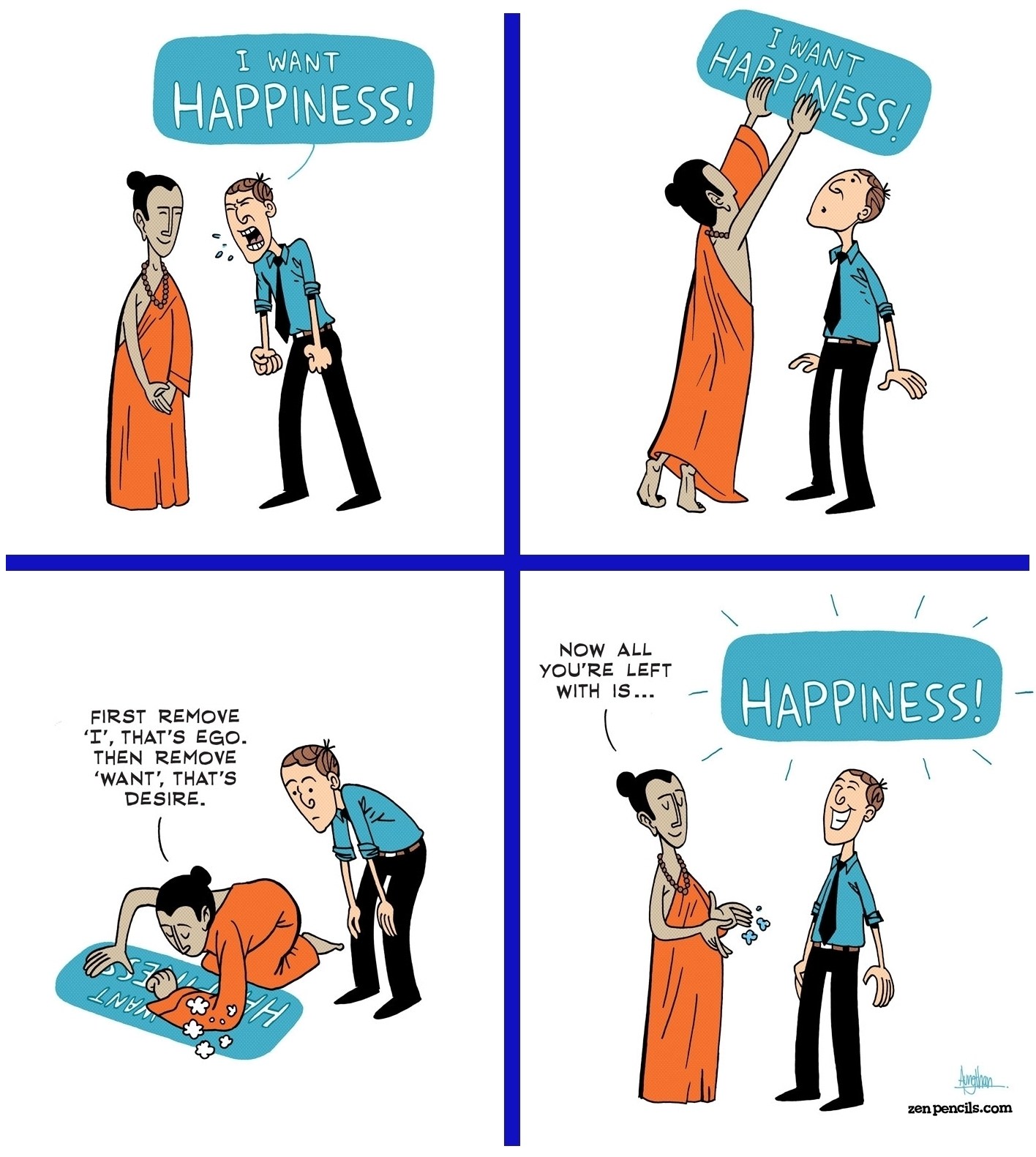
How can you achieve communication enlightenment? It's easier than you think.
Read moreThe New Old Normal
What feels normal to us, seems extraordinary to most others.
Read more